
General Questions
Driveway Gates & Automatic Gate Openers – Help & frequently asked questions NZ
Looking for advice about driveway gates or automatic gate openers?
EasyGate manufactures aluminium sliding and swing driveway gates in Tauranga and supplies automatic gate openers, remotes, keypads, safety devices and access-control equipment throughout New Zealand.
Below you'll find answers to common questions about choosing the right driveway gate, measuring your entrance, sliding vs swing gates, sloping driveways, gate automation, DIY installation, 24V power, safety beams, delivery, manuals and technical support.
If you're unsure which gate or automation system is right for your property, send EasyGate your driveway measurements and photos of the entrance and we can help you choose a suitable solution.
1. Can I buy an automatic driveway gate from EasyGate?
Yes. EasyGate supplies complete automatic driveway gate solutions, including custom-made aluminium sliding and swing gates, automatic gate openers, remotes, keypads and access-control accessories.
Our gate automation systems generally use extra-low voltage 24V motors, so you do not normally need 230–240V mains power at the gate motor. The EasyGate Plug-n-Go step-down transformer, included with our automation kits, converts 230–240V mains power to an extra-low voltage 24V supply.
This can make installation much simpler, particularly at driveway entrances where mains power is not already available at the gate. For many installations this can also provide a significant cost saving, as the long cable run to the gate can use 24V extra-low-voltage cabling rather than 230–240V mains cabling.
You can purchase a new EasyGate gate and automation system together, buy a gate now and add automation later, or purchase an automatic gate opener for an existing suitable sliding or swing gate.
EasyGate manufactures our aluminium gates at our Tauranga factory and supplies gates and automation factory-direct throughout New Zealand. If you're unsure which gate or automatic opener you need, contact us with your driveway measurements and we can help you choose a suitable system.
2. How much does an automatic driveway gate cost in NZ?
The cost of an automatic driveway gate in New Zealand depends on the gate size and design, whether it is a sliding or swing gate, the automation required and your installation conditions.
At EasyGate, you can purchase the aluminium driveway gate and automatic gate opener separately or together, allowing you to choose a system that suits your property and budget.
Based on current EasyGate website pricing, automation-suitable aluminium driveway gates start from around $1,049 incl GST for a Manor swing gate and $1,329 incl GST for a Manor sliding gate.
Automatic gate openers currently start from:
- $999 incl GST for a Boxer 500 automatic sliding gate opener kit.
- $999 incl GST for a Terrier single swing gate opener kit.
- $1,199 incl GST for a Terrier double swing gate opener kit.
This means an EasyGate gate and automation combination can start from approximately $2,000–$2,400 incl GST, before freight, installation and additional accessories, depending on the gate dimensions and system selected.
Larger gates, premium designs, heavier-duty motors, custom powder coating and additional access-control equipment will increase the price.
Contact EasyGate with your Post Gap, required gate height and whether you prefer a sliding or swing gate, and we can provide a more accurate price.
3. Sliding or Swing driveway gate – which is best for my property?
The best choice depends on your driveway layout, available space, slope, wind exposure and how you want your gate to operate. Both sliding and swing driveway gates can be automated.
Swing gates are generally simpler to install and are a good choice where there is plenty of clear space for the gate or gates to swing open. They can be manufactured as either a single or double swing gate.
However, the driveway needs sufficient room for the opening arc. Wind exposure should also be considered, particularly with larger or more solid gate designs. Swing gates take up driveway space as they open, so vehicles cannot be parked within the opening arc.
If installing double swing automation, low-voltage cabling will normally need to be run to the base of both gate posts.
Sliding gates move sideways along the boundary rather than swinging into the driveway, making them an excellent choice where driveway space is limited or where a swing gate would interfere with vehicles.
A standard sliding gate requires sufficient space beside the driveway for the gate to slide into, together with suitable foundations and wheel track.
If the ground drops away behind the fence line, EasyGate may suggest using our wheel-track monorail system, which can reduce the installation work required to create a solid foundation supporting the gate in its open position.
If there isn't enough side space for a conventional sliding gate, EasyGate also manufactures telescopic, cantilever and radius sliding gate solutions for more challenging driveway layouts.
If you're unsure, send EasyGate photos of your driveway entrance together with the Post Gap and available side space, and we can help you choose a suitable gate type.
4. Can I install an automatic driveway gate myself?
Yes. Many EasyGate customers install their own driveway gates and automatic gate openers, or arrange for a local builder, electrician or gate installer to complete some or all of the installation.
EasyGate specialises in factory-direct, supply-only aluminium driveway gates and DIY-friendly gate automation systems. We provide installation information and downloadable manuals for customers who are comfortable carrying out their own installation.
Our extra-low voltage 24V automatic gate openers can also make DIY installation easier. EasyGate TMT automation systems use a Plug-n-Go step-down transformer that can be positioned at a suitable 230–240V power point away from the gate, with the 24V extra-low-voltage supply cable running to the gate automation.
How much of the installation you do yourself depends on your skills and the type of gate. A swing gate is generally simpler mechanically, while a sliding gate may require concrete foundations, track installation and accurate alignment.
Any 230–240V mains electrical work that is required should be carried out by an appropriately qualified person.
EasyGate can manufacture your gate to the measurements you provide and supply the gate, automation, hardware and accessories for delivery throughout New Zealand.
5. How do I measure my driveway for a sliding gate?
To manufacture your sliding driveway gate correctly, EasyGate needs the Post Gap, opening direction, available side space and finished gate height. We also need to know whether the gate will be automated or non-automated, as this affects the overall gate length.
Post Gap
Measure accurately from the inside face of one gate post to the inside face of the other gate post.
EasyGate will calculate the finished gate length from this measurement and make the necessary allowances for overlap and the gate setup.
Opening Direction
Stand on the street side looking towards your property and tell us whether the gate will slide:
Left to right to open, or
Right to left to open.
This is important because it determines which end of the gate requires the additional length and where components such as the guide rollers and automation are positioned.
Gate Overlap and Additional Length
At the closing end, allow approximately 50 mm minimum overlap past the inside face of the closing post.
For an automated sliding gate, approximately 300 mm of additional gate length is required at the rear of the gate. This provides the additional gate structure required for the guide-roller and automation arrangement.
For a non-automated sliding gate, EasyGate includes a tail at the rear of the gate. This allows the top guide roller to remain inside the gate post, supporting the gate and keeping it upright and correctly aligned.
Available Side Space
Measure the clear space available beside the driveway in the direction the gate will slide.
There must be enough clear side space for the complete gate, including its rear extension or tail, to move fully clear of the Post Gap when the gate is open.
Check for anything that could restrict the gate, including fences, walls, buildings, downpipes, landscaping or changes in ground level.
Finished Gate Height
Measure from the driveway or finished ground level to where you want the top of the gate to finish — for example, 1.5 m or 1.8 m.
EasyGate will make the appropriate allowance for the wheels and track when calculating the manufactured gate height.
Driveway Contour
Also check whether the ground between the two gate posts is level or whether it rises or falls from one side to the other. A change in contour may require EasyGate to manufacture a raked or parallelogram sliding gate.
If you're unsure about any of these measurements, send EasyGate photos of the complete driveway entrance together with your measurements before ordering. We can help check that you've provided the information we need to manufacture your gate.
6. How do I measure my driveway for a swing gate?
EasyGate mainly needs the Post Gap, finished gate height, driveway contour and whether you want a single or double swing gate.
Post Gap
Accurately measure from the inside face of one gate post to the inside face of the other post.
EasyGate uses this measurement to calculate the actual gate width, allowing for hinges and the required closing gap.
Finished Gate Height
Measure from the driveway or ground level to where you want the top of the gate to finish.
Single or Double Swing Gate
Tell us whether you want one gate leaf spanning the driveway (single swing) or two gate leaves meeting in the centre (double swing).
Driveway Contour and Opening Clearance
Check whether your driveway is level from left to right between the gate posts. Also check whether the driveway rises or falls as you enter the property.
A change in level can affect the clearance underneath a swing gate as it opens.
If the driveway rises inward, measure the amount of rise over the area through which the gate will swing and provide the measurement to EasyGate in millimetres.
If you're unable to calculate this yourself, we suggest asking a builder or similarly qualified person to take the measurement. If in doubt, please send EasyGate a photo of your driveway entrance.
Automation Arm Clearance
Allow at least 200mm clearance from the hinge face of the gate post to any obstruction, such as a fence, wall or other structure, where the automation arm is to be installed.
7. What is the best gate for a sloping driveway?
For many sloping driveways, a sliding gate is the best option because it moves sideways rather than swinging across the slope.
However, the best solution depends on whether your driveway slopes up or down from the road or falls from one side of the entrance to the other.
A swing gate needs sufficient ground clearance throughout its opening arc. If the driveway rises behind the gate, a conventional inward-opening swing gate may hit the ground as it opens.
A sliding gate avoids this opening arc, making it particularly useful where the driveway rises or falls inside the property.
If the driveway has a fall from one side to the other, EasyGate can manufacture a sliding gate with the frame designed to follow the slope of the driveway. This is sometimes referred to as a raked or parallelogram sliding gate.
Send EasyGate photos of the complete driveway entrance together with measurements showing the amount and direction of the slope, and we can help determine the most suitable gate configuration.
8. What type of driveway gate is best in high winds?
For exposed or high-wind locations, an open-style aluminium gate is generally a better choice than a fully enclosed gate because it allows more wind to pass through rather than acting like a large sail.
Gate size, design, location and whether the gate is sliding or swinging all affect the wind loading on the gate and its automation.
Open picket or slat-style gates generally allow more airflow and can therefore reduce wind loading.
Solid or privacy-style gates, such as closely spaced slats, louvres or Tongue & Groove designs, have considerably more surface area exposed to the wind.
Wind is particularly important with swing gates because the gate leaf acts as a lever against the hinges and automation as wind pressure increases.
Sliding gates can often be a better option for exposed locations because they don't swing out into the wind. However, a sliding gate still needs appropriate support, guides and automation.
EasyGate has been manufacturing aluminium driveway gates in Tauranga since 2004 and can design specialist gate solutions for challenging or high-wind locations.
9. What automatic gate motor do I need?
The correct automatic gate motor depends on whether you have a sliding or swing gate, gate size and weight, gate design, wind exposure and how frequently the gate will operate.
For a sliding gate, considerations include gate weight and length, how freely the gate rolls, daily usage and whether the gate has an open or solid design.
For a swing gate, the length and weight of each gate leaf are important, but wind loading is also a major consideration.
Frequency of operation matters too. A residential driveway opening a few times each day has different requirements from an apartment complex or commercial entrance operating many times per hour.
If you're unsure which gate motor you need, send EasyGate:
- Sliding or swing gate
- Gate length and height
- Approximate weight, if known
- Photos of the complete gate and driveway
- Whether the gate is open-style or solid/privacy-style
- Wind exposure
- Approximate number of openings per day
- Residential, lifestyle or commercial use
EasyGate can then recommend an automatic gate opener suitable for your application.
10. Can EasyGate automate my existing driveway gate?
Yes. In many cases, EasyGate can supply an automatic gate opener for an existing sliding or swing driveway gate, provided the gate is in good condition and operates correctly by hand.
Before adding automation, the gate should move freely without binding, dragging or requiring excessive force.
An automatic gate motor should not be used to overcome problems with the gate itself.
For an existing sliding gate, we need to know its length, height and approximate weight, together with information about the wheels, track and available motor-mounting space.
For an existing swing gate, we need the width and height of each leaf, hinge position, gate-post dimensions and available motor space.
For our standard swing-gate automation, allow at least 200mm clearance from the hinge face of the gate post to a fence, wall or other obstruction.
Send EasyGate several photos showing the complete gate, posts and driveway area together with the gate dimensions, and we can advise which automation system may be suitable.
11. Where can I buy automatic gate openers and accessories in New Zealand?
EasyGate supplies automatic gate openers for sliding and swing driveway gates, together with remotes, keypads, safety devices and access-control accessories, factory-direct to homeowners, installers and businesses throughout New Zealand.
12. Do I need mains power at my driveway gate?
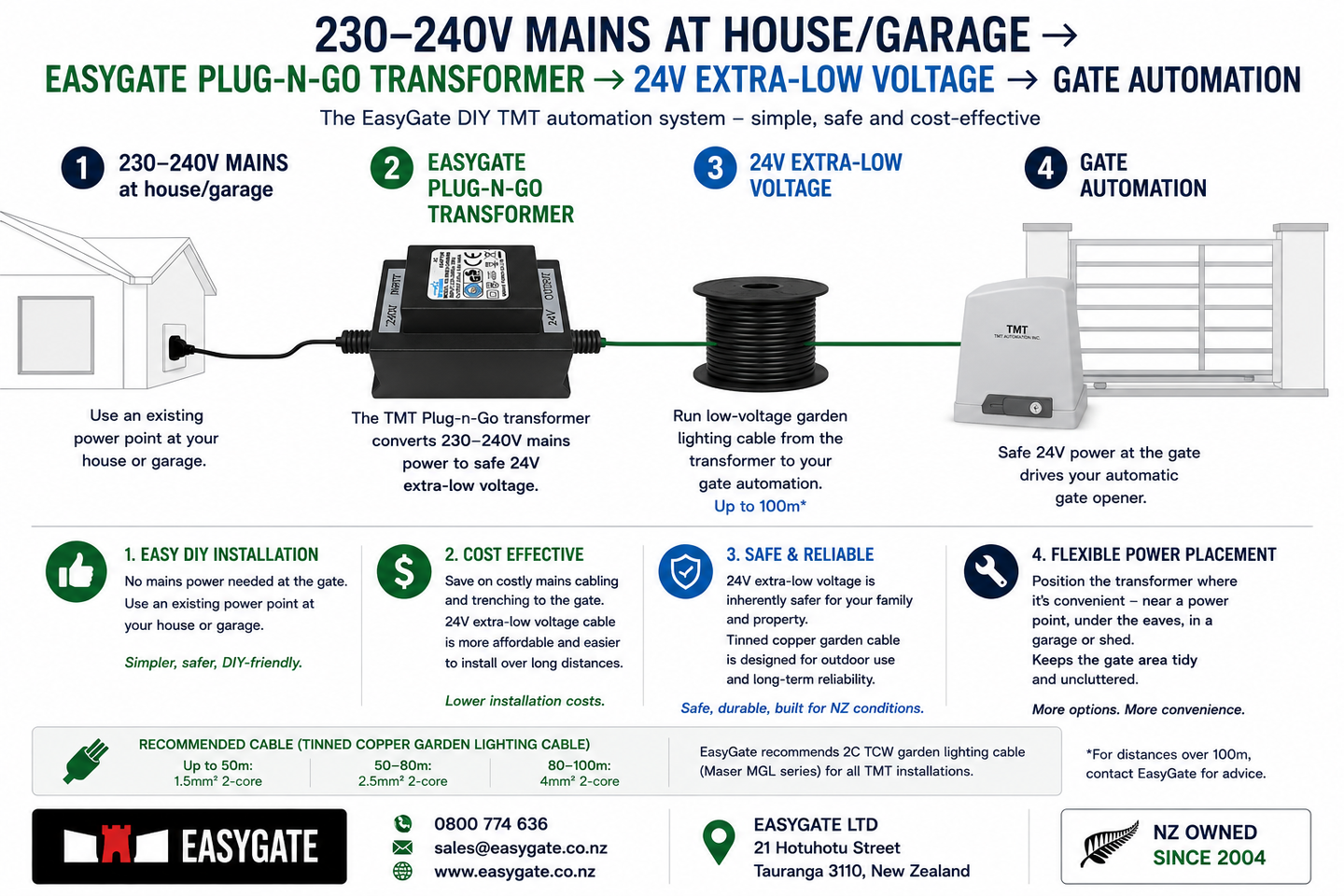
Not necessarily. EasyGate's TMT automatic gate openers generally use 24V extra-low-voltage motors, so 230–240V mains power does not normally need to be connected directly at the driveway gate.
The EasyGate Plug-n-Go transformer converts 230–240V mains power to a 24V extra-low-voltage supply.
This means the transformer can be located at a suitable mains power point at your house, garage or another convenient location. Appropriately sized 2-core garden-lighting cable can then carry the 24V supply to the gate automation.
230–240V mains at house/garage → EasyGate Plug-n-Go transformer → 24V extra-low voltage → gate automation
This can make installation simpler and, in many situations, save the cost of running 230–240V mains power all the way to the driveway gate.
13. How far can my gate transformer be from the automatic gate motor?
EasyGate recommends appropriately sized 2-core garden-lighting cable between the supplied TMT transformer and the gate automation.
For our standard TMT automation installations, our recommended cable sizes are:
| Transformer-to-gate distance | Recommended cable |
|---|---|
| Up to 50 m | 1.5 mm² 2-core garden-lighting cable |
| Up to 80 m | 2.5 mm² 2-core garden-lighting cable |
| Up to 100 m | 4 mm² 2-core garden-lighting cable |
EasyGate uses Maser 2C TCW garden-lighting cable, which uses stranded tinned-copper conductors and is designed for outdoor extra-low-voltage applications.
The larger cable sizes are recommended for longer distances to help reduce voltage drop. Gate automation also draws more current during periods of higher load, including start-up, before reducing as the opening or closing cycle progresses.
We do not recommend using small network/data cable, such as Cat5 or Cat6, to supply power to the gate automation.
For distances over 100 m, contact EasyGate before installing your cable.
14. What colours are available for aluminium driveway gates?
EasyGate aluminium driveway gates can be powder coated in a wide range of colours to complement your home, fencing, aluminium joinery or Colorsteel® roofing.
We keep a selection of popular powder-coat colours in stock, while less commonly requested colours can usually be specially ordered and quoted.
Satin Black is our standard colour for many EasyGate picket-style gates and is included in the standard pricing of those products.
If you want to match existing aluminium joinery or Colorsteel roofing, tell us the manufacturer's colour name and we can help identify the appropriate powder-coat colour.
We cannot guarantee an exact match to conventional house-paint colours.
View our Powder Coating Colours page for the current EasyGate colour options.
15. Does EasyGate deliver driveway gates throughout New Zealand?
Yes. EasyGate manufactures aluminium driveway gates at our Tauranga factory and arranges delivery to customers throughout New Zealand.
We regularly supply sliding gates, single and double swing gates, pedestrian gates, automatic gate openers, hardware and access-control equipment nationwide.
Because EasyGate operates primarily as a factory-direct, supply-only manufacturer, you don't need to be located in Tauranga to purchase an EasyGate gate.
Your gate can be custom manufactured to your measurements, powder coated at our Tauranga factory and prepared for transport to your location.
Freight costs depend on the size of the gate and delivery destination and will be confirmed as part of your quotation.
16. Does EasyGate install gates or supply them only?
EasyGate operates primarily as a factory-direct, supply-only gate manufacturer and automation supplier. We manufacture your aluminium driveway gate at our Tauranga factory and can arrange delivery throughout New Zealand, but we do not normally provide on-site measuring or installation.
Many EasyGate customers measure and install their own gates, while others use a local builder, gate installer, electrician or other suitable contractor.
By concentrating on what we do best — manufacturing aluminium gates and supplying automatic gate openers, hardware and access-control equipment — EasyGate can supply customers nationwide directly from our Tauranga factory.
If you're unsure about your measurements, send us photos of your driveway entrance and measurements before ordering, and we can help check that you've provided the information we need.
17. How do automatic gate remotes work?
Automatic gate remotes work in a similar way to a garage-door remote. Pressing the programmed button sends a wireless signal to the gate's control system, telling the automatic gate opener to operate.
With most EasyGate automation systems, one press starts the gate opening. Depending on the system and programming, another press may stop the gate or operate the next part of its open/stop/close sequence.
Many EasyGate gate openers can also be programmed with an automatic closing function.
Additional remotes can usually be programmed into the system for family members, staff or additional vehicles.
EasyGate also supplies wireless keypads, vehicle detection and other access-control options.
If you need an additional or replacement remote, identify your EasyGate automation model or existing remote first so we can help select a compatible unit.
18. Do I need safety beams on my automatic driveway gate?
EasyGate recommends safety beams on all automated driveway gates. They are particularly important when using the auto-close function or when the gate can be activated remotely.
Safety beams, also known as photocell safety beams, create an invisible beam across the gate opening. If a vehicle, person or other obstruction breaks the beam, the gate control system can detect the obstruction and respond according to how the automation has been programmed.
Safety beams are particularly important where vehicles may stop in the path of a closing gate, children may be near the gate, the gate can be activated remotely, or the gate is not clearly visible to the person operating it.
EasyGate recommends including safety beams when planning any new automatic sliding or swing driveway gate.
19. Where can I download an EasyGate gate opener manual?
EasyGate provides free downloadable manuals for our automatic gate openers, control boards, keypads, safety devices and other gate automation accessories.
Visit the EasyGate Manuals page and select the model of gate opener or accessory you have.
The page includes manuals for sliding gate motors, swing gate openers, control boards, keypads, vehicle detectors, safety beams and other accessories.
If you're having a technical or programming problem, we recommend checking the relevant manual first, as many installation, programming and troubleshooting questions are covered there.
If you're unsure which gate opener or control system you have, compare your equipment with the product photos in EasyGate's Automation & Parts catalogue.
The Manuals page also contains useful EasyGate installation guides, including sliding-gate and cantilever-gate installation information.
20. Can EasyGate repair a damaged aluminium gate?
EasyGate can assess damaged aluminium gates for repair, including gates we have not manufactured, but every damaged gate needs to be considered individually. We do not repair timber or steel gates.
In many cases, particularly where there is significant damage, manufacturing a replacement gate can be more practical and cost-effective than repairing the existing gate.
Factors include the extent and location of the damage, whether the frame has twisted, removal of existing powder coating, fabrication and welding work, re-powder coating and transport costs.
Email EasyGate several photos showing the complete gate and close-up photos of the damage, together with the overall gate height and length.
We can then give you our initial opinion on whether repair or replacement is likely to be the better option.
21. How do I return gate automation for a technical check?
If you would like EasyGate's technicians to inspect an automatic gate opener, control board or other gate automation equipment, please complete our Technical Check/Return Form before sending the equipment to us.
Complete the online form with as much information as possible about the equipment and the problem you are experiencing.
Once completed, print a copy of the form and include it with the equipment being returned.
Providing clear information about the fault, including what the gate was doing when the problem occurred and any troubleshooting already carried out, will help our technicians assess the equipment efficiently.
Returned equipment cannot be assessed or actioned if the Technical Check/Return Form has not been completed or insufficient information is supplied with the equipment.
I would put your existing Technical Check / Return Form button immediately underneath this answer.
22. Who is EasyGate and how long have you been manufacturing gates?
EasyGate Ltd is a New Zealand gate manufacturer established in Tauranga in 2004. For over 20 years, we have specialised in manufacturing aluminium driveway gates and supplying automatic gate openers and access-control equipment to residential, lifestyle and commercial customers throughout New Zealand.
Our aluminium gates are manufactured at our Tauranga factory, with powder coating also completed on site.
We manufacture custom sliding gates, swing gates and specialist gate solutions, together with supplying gate automation systems, hardware and accessories.
EasyGate operates primarily as a factory-direct supplier from Tauranga, with delivery available throughout New Zealand.